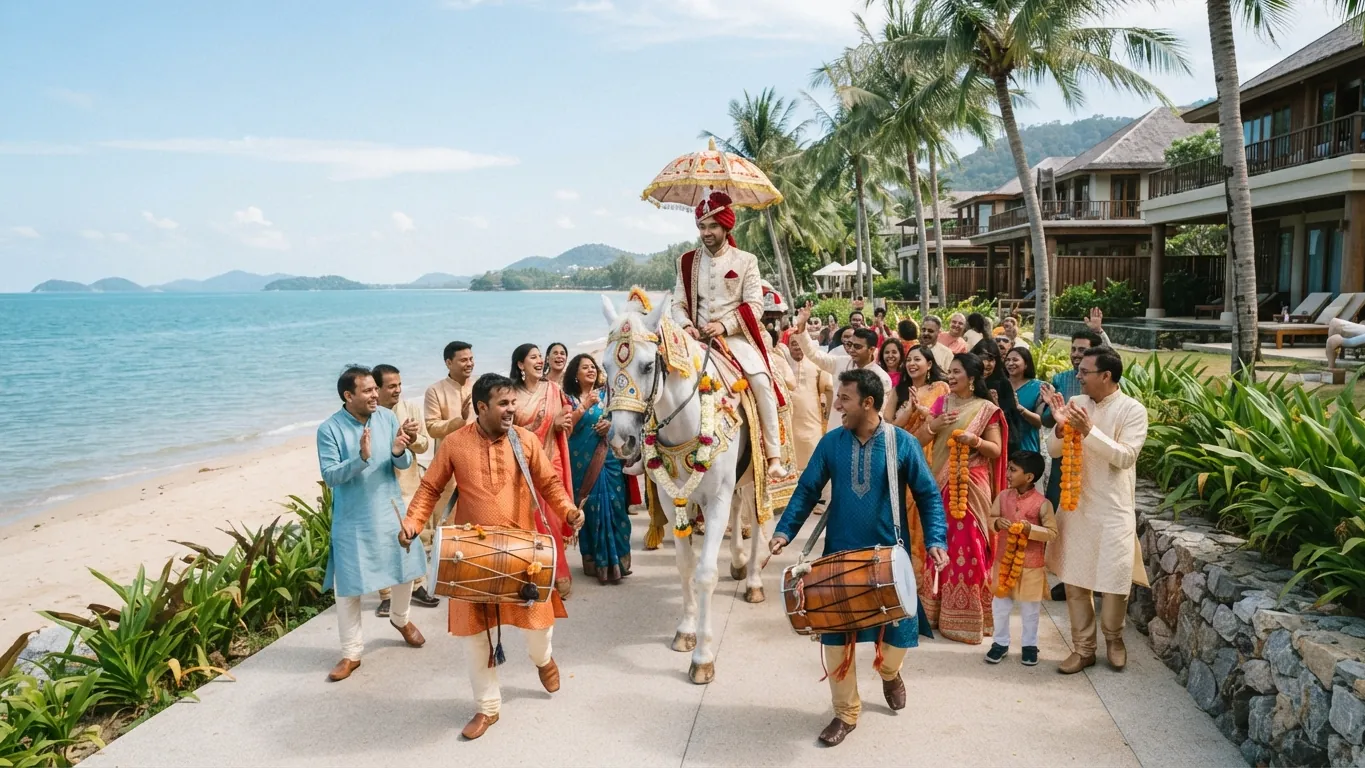
The baraat is the groom's wedding procession. He arrives at the ceremony with his family and friends, traditionally on a decorated white mare, while dhol drummers play and his side dances the whole way. The bride's family waits at the entrance to receive them. It is one of the happiest moments of a North Indian wedding, and the one most likely to run late.
Who joins the baraat?
The groom's family and friends walk and dance with him. Guests from the bride's side wait at the venue for the welcome. At destination weddings, many guests know both families, and nobody minds if friends of the bride join the dancing. They should be back at the entrance before the groom arrives.
Horse, car or boat?
| Option | What to check |
|---|---|
| White mare | A calm horse used to drums and crowds, a handler who walks beside it, shade and water before and after, and a short route on firm ground |
| Vintage or open car | Path width, a slow driver, and a spot to stop for the dancing |
| Decorated golf buggy | Easy inside resorts with long paths, and kind to grandparents |
| Boat arrival | Calm sea, a jetty or shallow landing, and a backup plan for wind |
Elephants appear in old wedding photographs, but riding and parade use draw growing welfare criticism in Thailand and many resorts no longer allow it. A horse or a car is the safer choice for the animals, the guests and the photographs.
Route and timing
Keep the route between 150 and 300 metres, ideally on a paved resort path or firm sand above the tide line. That distance takes thirty to forty five minutes once dancing starts. Mark three stops where the procession pauses for the biggest songs, and agree with the planner when the music must move on so the muhurat, the auspicious time for the ceremony, is kept.
Time the baraat for morning or late afternoon. Midday sun on a Thai beach in March or April is punishing for guests in silk and for the horse. Set up water stations along the route, umbrellas for elders, and handheld fans if the procession is long.
Music and sound
Dhol players set the pace. Two drummers carry a procession of 100 people. Some families fly dhol players in from India, and some local entertainment companies supply them. Add battery powered speakers on a cart or buggy for the songs between drum sets, with a DJ walking beside it on a wireless controller.
Songs families come back to include Aaj Mere Yaar Ki Shaadi Hai, Mere Yaar Ki Shaadi Hai, Gallan Goodiyaan, Tunak Tunak Tun, Kar Gayi Chull and Morni Banke. Open with something everyone knows, and save the Punjabi bangers for the stops.
Permissions on the sand
In Thailand, beaches are public land. A procession that stays on resort grounds is the resort's business. One that crosses a public beach may need permission from the local authority, and fireworks or confetti cannons need official approval. Ask the venue to confirm the route in writing, and keep the procession on its own land when you can. Local rules on using beach land differ by area.
The milni and the welcome
When the baraat reaches the entrance, the bride's family welcomes the groom with an aarti and the milni, where elders of both families meet, hug and exchange garlands. Plan a shaded welcome spot with space for both families, a sound cue to stop the drums, and a photographer facing the groom, not his back.
Questions families ask
A baraat is the groom's wedding procession to the ceremony venue, led by dhol drummers with family and friends dancing around him. The groom traditionally rides a decorated white mare.
The groom's family and friends join the procession. The bride's side of the family tends to wait at the venue entrance to welcome him, though at destination weddings many guests dance with both sides.
Thirty to forty five minutes for a route of 150 to 300 metres. Longer routes tire guests and risk the ceremony time.
Yes. Planners in Phuket and Hua Hin source calm horses with experienced handlers. Keep the route short, on firm ground, with shade and water for the horse.
Families often choose Aaj Mere Yaar Ki Shaadi Hai, Gallan Goodiyaan, Tunak Tunak Tun, Kar Gayi Chull and Morni Banke, with live dhol between tracks.